

A slightly different post to the usual ones!
If you’re a regular reader, you’ll already know that I volunteer monthly at a local repair café hosted by Climate Action Stokesley & Villages (CASaV), a group who aim to help communities in Stokesley and the surrounding villages to take action on climate change by supporting and developing local initiatives to reduce carbon emissions and/or adapt to the changing climate, primarily through the following major principles:
- Energy: reducing energy consumption; increasing renewables usage.
- Nature: maintaining the local environment; planting more trees.
- Food: promoting sustainable food.
- Transport: reducing our reliance on fossil fuel powered vehicles.
- Waste: promoting methods of reducing, reusing, and recycling.
Repair cafés focus on waste, specifically by trying to repair items and allow them to be reused instead of being binned or sent for recycling. People are encouraged to bring along items that they need repaired, and to be involved in the repair process themselves – repairs are free, though owners can give a voluntary donation if they’re happy with the service.
Repair cafés usually cater for a large range of items, including:
- Electricals (i.e. white goods, TVs, vacuum cleaners, kettles, toasters, lawnmowers, etc.).
- Electronics (i.e. radios, computers, laptops, phones, tablets, monitors, speakers, etc.).
- Furniture (i.e. woodwork, upholstery, etc.).
- Textiles (i.e. clothes, bedding, etc.).
- Toys (i.e. soft toys, electronics, etc.).
- Knives (i.e. sharpening).
- Bicycles (i.e. servicing).
CASaV hold regular repair cafés at both Stokelsey (Globe Community Library) and Swainby (Village Hall), so if you’re local, please do consider coming along – either as a guest with something that you’d like to have repaired, or as a volunteer (either for one of the repair teams if you have the appropriate skills and tools, or as support) if you’d like to help.

If you’re not local but would still like to get involved, CASaV is only a small part of the International Repair Café movement, so there may already be one closer to you. If not, please consider starting one! The IRC can offer support for this purpose.
Anyway, back to the main focus of this post – at a repair café in November, someone brought in a very old and rather interesting piece of kit: a 1950s English Electric 2750S heated serving tray, used to keep food warm for a buffet. This was quite a sentimental item for them, and they wanted it to be brought back to working order.


English Electric merged with General Electric in 1968, prior to which they manufactured consumer and industrial electronics, nuclear reactors, guided missiles, and military aircraft such as the iconic Canberra and Lightning.
I’m not joking when I say that, in its initial condition, this thing was lethal – its mains cable was the original from the 1950s, with rubber insulation that had deteriorated so badly that bare mains conductors were showing. The inline switch was the original bakelite one. Aside from that, it was also absolutely filthy, and had been stored in a damp location for several decades so the metalwork was badly corroded.


If the external wiring was shot, likelihood is that the internal wiring was shot too, so I pulled it apart to inspect how it was designed internally – the cabling was still rubber, it used some bakelite terminal blocks, and the silver heating element was across mains in series with a dropper resistor to give approx. 6Vac to power a small dial lamp.
In terms of safety, the chassis was earthed, but there was no internal fusing. The heating element measured approx. 200Ohm cold, which seemed about right.


I had a plan as to how best to rewire the unit and make it a fair bit safer for modern use, but I couldn’t test this plan out until I’d cleaned it all up – it was absolutely disgusting to work with. I dismantled the frame (which is only held together with screws and fixings), cleaned up the glass panels with degreaser, acetone, and glass cleaner (taking care not to damage the printed silver heating element), and cleaned up all of the metalwork and fixings with metal polish and a microfibre cloth.


Now I could start on the electrical work: I fitted a new 2m earthed mains cable with UK moulded plug (3A fused), with a new 6A-rated inline switch with live/neutral switching and earth passthrough, and a new cable grommet with strain relief from a cable tie; I earthed the chassis as before using an eyelet crimp, and added a 10mm x 10mm CPC sticker next to the screw; I replaced the original insulation on the original heating element tails with heatshrink and crimped new cables to them, as I didn’t want to damage the silver by heating it with a soldering iron; I wired a 3A 102C thermal fuse on the mains input, for overcurrent and overtemperature protection; I fitted an amber 230Vac 8mm LED indicator in place of the original dial lamp and dropper resistor, and wired this in parallel with the heating element. I did all of this using WAGO 221-series maintenance-free push-fit connectors instead of terminal blocks, as no live parts are accessible.


I reassembled the unit for initial testing, and checked the resistance between earth and all of the metal parts and fittings on the chassis – this was OK, so I plugged it in and switched it on. The indicator LED lit up and the heating element started heating up, with the power draw settling down to around the 400W expected rating – after a while running the glass tray ended up getting extremely hot, with a hotspot of 105C in one small area where the heating element was quite thin, about 82C around the mains input to the element, and about 70C over the rest of the panel.


As far as I am concerned, this is far too hot to be safe, and could cause third-degree burns with limited skin contact before you could even react. I wasn’t happy to give the unit back in working condition reaching these kind of temperatures.
The problem with this old-fashioned design is that the temperature control is completely open-loop: there is no temperature feedback, and the power to the heating element is not regulated in any way (apart from by its own resistance versus temperature), so changes in the mains voltage, cold resistance, and ambient temperature will not be accounted for.
It would be quite complicated to make this into a more modern system, with some form of closed-loop control system using feedback from temperature sensors to regulate power through the heating element to maintain a temperature setpoint. I decided to try something more simple, because all we needed to do was bring the power down – the temperature doesn’t need to be very stable, just not unsafe.
I decided to fit a large rectifier diode (1N5408, 1000V 3A) on the live input to the heating element to form a half-wave rectifier – this effectively blocks half of the mains AC waveform into the heating element, reducing the effective power through it by at least half. Because the load is purely resistive, powering by half-wave AC should be fine.

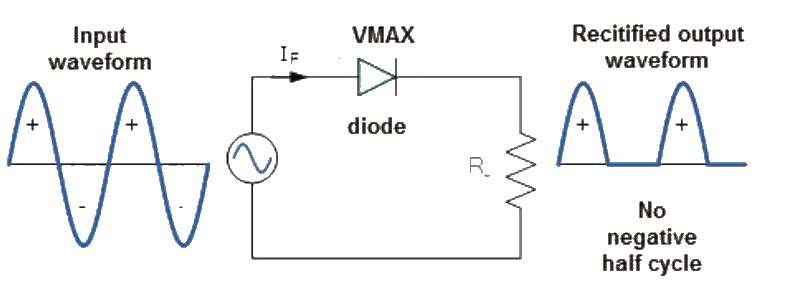


With the diode fitted, as expected the power draw dropped significantly – after being left for a while to warm up, the glass panel evened out to around 60C overall, with the small hotspot sitting at around 65C.
Apparently, the average person can touch a 60C surface for up to five seconds without sustaining irreversible burn damage – also, the Food Standards Agency recommends that “hot holding” equipment like buffet trays keep food above 63C, so with these modifications the tray is running pretty close on both marks.


The tray was then PAT tested by the repair café and safety inspected, then returned to a very grateful owner with the following instructions: do not leave it unattended whilst it’s on, let it warm up for half an hour before using it for food, and ensure that nobody hurts themselves on the high-temperature glass, especially children.

The tray cleaned up well – it’s a beautiful piece of design, a nice piece of engineering, & an interesting piece of history, so I’m glad that it didn’t end up in landfill.


I remember well my family having the same heated tray. We used to use it for Sunday lunches to keep the roast and side warm for ‘seconds’. I always really liked that they made a feature of the heating element, but I suspected the electrics were as shoddy as you showed they are. I have to commend your clever alteration of its operation to make it safe. Very nice work indeed.
Thank you very much 😊 Yes, it is a really lovely design, the zig-zag silver element is a really nice feature. It’s very cool that your family had the same one!